

Posters above the sofa – choosing sizes and placement
What size works above the sofa? Start with the sofa’s width and the free wall space. Add the frames’ outside dimensions and the gaps, then try the whole group with paper templates. You can see what fits before ordering or making holes.
This guide gives you a worked example for a 200 cm sofa, a calculation you can adapt and ways to adjust an arrangement that feels too small, too high or too crowded.
1. Measure the space for your posters
You need a tape measure, paper for templates and something to write on. Measure the sofa’s width and note the highest point of its back. Then measure the free wall space: lamps, shelves, sloping ceilings and curtains can limit it even on a wide wall.
Use the sofa’s position when testing where to centre the group. A sofa off to one side does not need its posters centred on the entire wall. Check the view from the doorway and other seats too.
2. Include the frame, not just the poster size
A frame for a 50 × 70 cm poster is larger than the poster itself. Use its outside dimensions when planning. If you use a mount, distinguish between the poster size, the mount opening and the frame’s picture size.
For two equally wide frames:
Group width = frame outside width + gap + frame outside width.
For more frames, add all outside widths and the gaps between them. Portrait and landscape arrangements have different widths; swap the dimensions when you turn a frame.
Example: two 50 × 70 cm posters above a 200 cm sofa
This example uses two portrait E-Line oak frames for 50 × 70 cm posters. BGA lists their outside dimensions as 52.4 × 72.4 cm. This is a published product specification, not a measurement of a frame in our studio. Check your own frame before marking the hanging points.
With 8 cm between the frames’ outside edges:
52.4 + 8 + 52.4 = 112.8 cm wide.
Centred above a 200 cm sofa, the group leaves 43.6 cm on each side measured to the sofa’s edges: (200 − 112.8) ÷ 2. Its height is 72.4 cm when the frames hang level.
The sofa width and gap were chosen to illustrate the calculation. They are not a furnishing rule. Try a different gap with the templates and compare.

3. Compare groups in different sizes
Two large posters and three smaller ones can have almost the same total width but different heights and effects. This table shows poster sizes only, without frames, with 8 cm gaps. Recalculate using outside frame dimensions after choosing your frames.
| Portrait posters | Width without frames | Height without frames |
|---|---|---|
| Two in 50 × 70 cm | 108 cm | 70 cm |
| Three in 30 × 40 cm | 106 cm | 40 cm |
| Three in 40 × 50 cm | 136 cm | 50 cm |
The first two groups have nearly the same width before framing. Consider height as well: a lower group may leave room for a wall lamp, while larger pictures can be easier to see across the room. Compare more formats in our poster size guide.
4. Test height and spacing before hanging
Cut paper templates to the frames’ outside dimensions. Mark each picture’s orientation so you do not mix up portrait and landscape. Attach them temporarily using a method suitable for the wall finish; test somewhere discreet if you are unsure.
Start with the whole group, then move individual templates. Sit on the sofa and check that its back, cushions and anyone sitting there will not touch the pictures. Then assess the arrangement standing up and from the entrance.
Photograph two alternatives from the same spot. This helps you judge whether to move the group or change the gaps. One fixed height from the floor will not suit every sofa and room.
If the arrangement does not feel right
| What you notice | What to try with the templates |
|---|---|
| The group looks small above the sofa | Try larger sizes or an extra picture. Avoid gaps so wide that the pictures lose their connection. |
| The pictures seem to float too high | Lower the whole group and check the clearance while someone sits on the sofa. |
| A lamp crowds the group | Try a narrower arrangement or another position relative to the sofa. |
| The pictures look scattered | Reduce the gaps and try a shared top edge or centre line. |
| The poster fits but the frame does not | Recalculate with the frame’s outside width and height. |
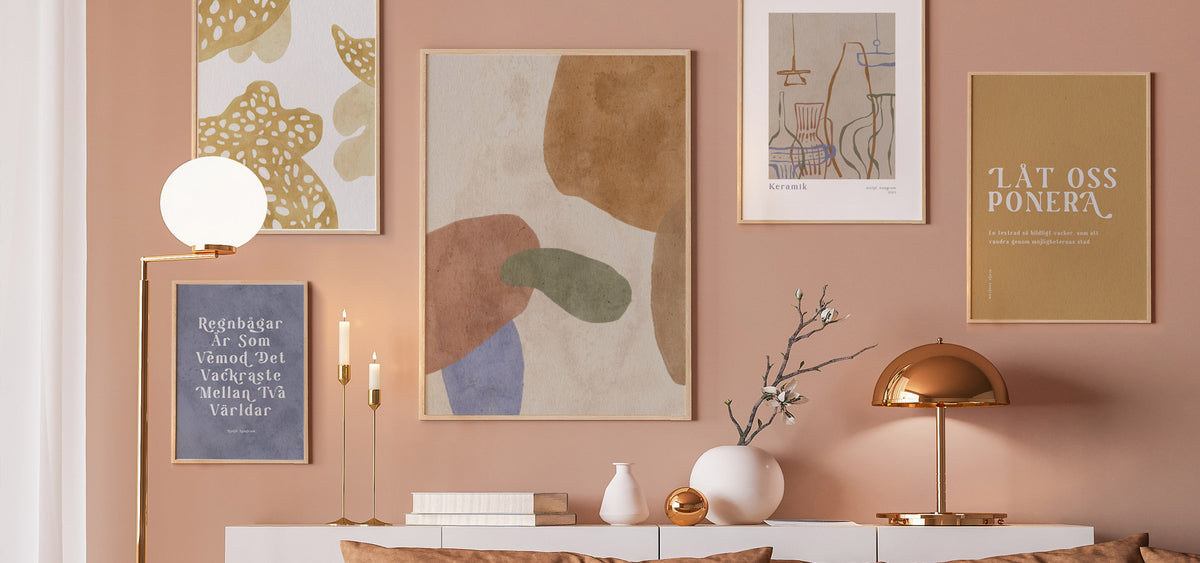
Choose designs once the dimensions work
Planning a larger group? Our guide to creating a gallery wall helps you connect designs and test arrangements.
Start with a poster you like and find a companion that shares a colour, shape or theme. The designs do not need to be nearly identical. Our selected poster pairs can give you a starting point.
For colour and combinations, see our separate living room poster guide. Here, dimensions and placement determine which sizes to compare.
Check before hanging
- The whole group fits, including frames and gaps.
- The position works sitting down and standing up.
- Your chosen designs are available in the planned sizes.
- You have checked each frame’s hanging point; the hook is not necessarily at its top edge.
- The fixing suits the wall material and picture weight. Follow the frame and fixing instructions.
When your templates are in the right place, compare posters for the living room in sizes you have room for.
Source for the frame dimensions
BGA: E-Line Oak 50 × 70 cm lists outside dimensions of 52.4 × 72.4 cm. Estancia: E-Line Oak describes the range. Specifications checked on 14 November 2026. Other frame models may have different outside dimensions.